Envisioning a convivial post-corporate world requires a diversity of new/old concepts, policies, technologies, best practices, etc. that are imaginable or currently available for decentralized implementation.

This blog is intended to collate promising contributions to this vision from experts in many fields.

Participants are requested to classify each of their posts with one or more of the Category Labels (listed here).

October 19, 2011

Forest Gardening - Permaculture

Forest Gardening with Robert Hart
More details and background on forest garden dynamics and design.

Courtesy of AppleseedGarden, which also offers a lot more edifying eco-agro-videos here.

September 21, 2011

Perpetual Bacterial Hydrogen Generators


Applied Sociocracy - Corp Democracy

Can a Company Be Run as a Democracy?

By JACLYNE BADAL
* The Wall Street Journal
* APRIL 23, 2007

During a recent strategy meeting at Ternary Software Inc., a programmer criticized the chief executive's new incentive plan for employees. An hourlong discussion ensued, in which several participants, including the CEO, critiqued the proposal. Ultimately, all six participants agreed to handle incentives differently.

That part was crucial: Ternary runs itself as a democracy, and every decision must be unanimous. Any of Ternary's 13 other employees could have challenged the incentive decision and forced it to be revisited.

Running a company democratically sounds like a recipe for anarchy, and it can prompt bureaucratic whiplash: Ternary, a company with annual revenues of around $2 million, adjusted salaries for employees up and down several times last year.

June 05, 2011

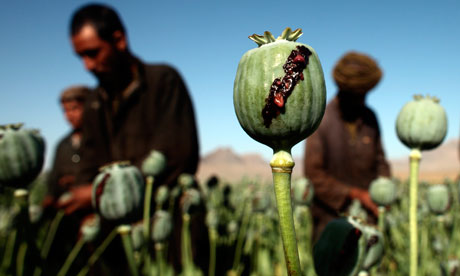
Influential retired officials push drug decriminalization

Leading world politicians urge 'paradigm shift' on drugs policy

AFGHANISTAN/
Afghans harvest opium in a poppy field.
Photograph: Goran Tomasevic/Reuters
Jamie Doward
The Observer
29 May 2011

Kofi Annan, George Shultz and Richard Branson among those urging public health approach.
     
     
    Former presidents, prime ministers, eminent economists and leading members of the business community will unite behind a call for a shift in global drug policy. The Global Commission on Drug Policy will host a press conference at the Waldorf Astoria hotel in New York to launch a report that describes the drug war as a failure and calls for a "paradigm shift" in approaching the issue. Those backing the call include Ernesto Zedillo, former president of Mexico; George Papandreou, former prime minister of Greece; César Gaviria, former president of Colombia; Kofi Annan, former UN secretary general; Fernando Henrique Cardoso, former president of Brazil; George Shultz, former US secretary of state; Javier Solana, former EU high representative; Virgin tycoon Richard Branson; and Paul Volcker, former chairman of the US Federal Reserve.

Agroecology Outstrips Industrial Agriculture on Multiple Fronts

Reimagining Food Systems in the Midst of a Hunger Crisis

A majority of the world's hungry are women and children
By Kanya D'Almeida,
IPS

June 3, 2011


"Analysing the data from the 2006 study by region, the International Fund for Agricultural Development (IFAD) found that in some parts of Africa the yield increase (from agro-ecological practices) was a stunning 213 percent."
 
WASHINGTON, Jun 3, 2011 (IPS) - Today one billion people are living in hunger, not because of scarcity of production or a shortage of food on shelves in the global marketplace, but because they "lack the most basic purchasing power needed to acquire it", Olivier De Schutter, the United Nations Special Rapporteur on the Right to Food, said Thursday.

Currently, 35-40 percent of harvests are lost due to inadequate transportation and storage facilities, while a further 35-40 percent goes to wealthy Organization for Economic Cooperation and Development (OECD) countries.

According to experts like De Schutter, the inability of 10 percent of the world's population to feed itself is also a reflection of unsustainable patterns of consumption and deeply flawed models of industrialised agricultural production which, if allowed to continue, will divert 50 percent of global cereal harvests towards feeding cattle by the year 2050.

February 25, 2011

RUSHKOFF: The Evolution Will Be Socialized

"I (suggest) we “fork” the Internet – that we accept the fact that the net is built on a fundamentally hierarchical architecture, surrender it to the corporations who run it, and consider building something else for ourselves."

The Evolution Will Be Socialized
Douglas Rushkoff
02.07.11

From the actions of the Egyptian government to the policies of Facebook, the monopolies of central banks to the corporatization of the Internet, we are witnessing the potential of a peer-to-peer networking become overshadowed by the hierarchies of the status quo. It’s time for us to gather and see what is still possible on the net, and what, if anything, can be built to replace it.

I have had a vague misgiving about the direction the net’s been going for, well, maybe 15 years. But until recently, it was more like the feeling when another Starbucks opens on the block, a Wal-Mart moves into town, or a bank forecloses unnecessarily on that cool local bookstore to make room for another bank.

Lately, however, what’s wrong with the net has become quite crystalized for me. It started with the corporate-government banishment of Wikileaks last year, and reached a peak with Egypt shutting off its networks to stave off revolution. The Obama administration seeking the ability to do pretty much the same thing in the US, Facebook’s “sponsored stories,” and the pending loss of net neutrality don’t help, either.

February 10, 2011

Using Greywater

February 09, 2011

A Geodesic Greenhouse — Year-Round Gardening at 6000 Feet